


















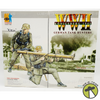
Dragon WWII German Tank Hunters Edmund Gross & Helmut Klein Action Figures NEW








Description
GERMAN TANK HUNTERS
While it seems as if the Panzer Divisions of the Wehrmacht have received most renown, the Infantry Divisions were far more numerous. Often, the only tank an infantryman might encounter would be that of the enemy. That being the case, the infantryman was most interested in any weapon that might help to defeat his armored foe. The heavy, crew served anti-tank guns were part of the solution but a weapon of "last resort" was still required.
At the beginning of the Second World War, the German infantryman was reasonably served by his anti-tank rifles, the 7.92mm Panzerbuchse models 38 and 34. Both of these were capable of penetrating 30mm of armor plate at 100 meters. These fired a solid shot and depended on sheer force to do the job. However, tank development progressed rapidly and as the armor thickened, the anti-tank rifles became less successful..
Nevertheless, the anti-tank rifle remained in service while the search for a more adequate replacement continued. In the meantime, the German infantryman had to rely on expedient measures to defend against enemy armor. Anti-tank mines were the obvious alternative and expedient explosives were made by securing six grenade heads around a single stick grenade. In 1942, a hollow charge, magnetic mine (Hafthohlladung 3) was introduced. Their effectiveness very much depended on the courage of the soldier who was trying to place them.
In Tunisia, 1943, the Germans captured an American 2.36 inch rocket launcher (bazooka) that was rushed back to Germany for examination. This resulted directly in the development of the Racket Panzerbuchse 43 (RP2B43). While it fired a larger 88mm (3.5 inch) rocket, it worked on the same basis as the bazooka". Essentially it was little more than a metal tube that electrically fired a rocket which was loaded into the back end. The RP.Gr.4322 rocket had an effective range of 150 meters (165 yds) but it could penetrate more than 8 inches of armor. The rocket blast could be hazardous to the shooter and protective clothing, along with a gas mask, were sometimes worn.
In 1944, the design was revised to include a blast shield and was thus designated RP2B54. A further development was the RP2B54/1 which featured a tube shortened to 1333 mm from 1638 mm. It was designed to fire the longer range (201m) RP. Gr. 4992 projectile which had a different electrical connection. Still, the 54/1 could still fire the 4322 missile. Both projectiles featured hollow-charge warheads that in effect, burned through armor plate They were stabilized with tubular fins. These rockets were transported in wooden packing cases with two rounds per be. A wooden back carrier was designed to carry five rockets, but it is is not wall documental Close to the front lines, spars rockets were only tucked behind an equipant strap.
These rocket launchers were given the nicknames of "Panzerschreck" (Tank Terrar) or "Ofenrohr (Stovepipe) and together with their cousin, the "Panzerfaust (Tark Devil), these weapons proved to be very effective against their armored for!
By the time that the first "Panzerschreck was in the hands of the infantryman, the typical uniform had evolved into the M43 pattern that featured pleatless pockets with straight cut flaps. The RP2B54 gunner was usually equipped much like his comrades. The webbing "A-frame battle pack could be attached to the rings on the combat suspenders. The suxiliary straps of the combat braces hooked on to the lower corners of the pack. The intent of the pack was to enable the soldier to carry all his basic requirements for combat. Although it wasn't always present, a small canvas bag was usually issued with the pack and it could carry the rifle cleaning kit and rations. The mass tin wiss strapped horizontally to the upper portion and the Zeltbahn (shelter quarter) was fastened below. While the battle pack was a very useful item, there never seemed to be an adequate number of them.
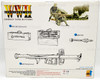
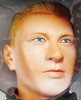
Highly flexible 1/6(12") body - Authentic uniform featuring fully detailed decorations - Life-like head with character - Triple jointed arms and legs allow the figure to perform difficult poses - Each piece of equipment is accurately reproduced in 1/6 scale
The box has some creasing, bending and scuffing.